
What’s the Hardest Pest to Get Rid Of? A Griffin GA Pest Pro’s Honest Answer
If you have ever sprayed, trapped, and cleaned your way through a pest problem only to watch it come back, you have probably wondered whether some pests are simply harder to get rid of than others. They are, and the reasons are more interesting than most people expect.
After decades in pest control, our answer to the question of the hardest pest to get rid of depends on what you mean by “hard.” Some pests are hard because you cannot see them. Some are hard because the way people usually fight them makes the problem worse. And some can be reduced but never fully eliminated. Here is how the toughest pests in Griffin and Spalding County break down.
The Hardest Pest to Get Rid Of in Griffin, GA: The Short Answer
For most homeowners, the hardest pest to get rid of is the German cockroach. Termites are the hardest to detect, and ants and mosquitoes each have a trick that defeats the usual DIY approach. The sections below cover each one.
German Cockroaches: The Hardest Pest for Homeowners to Get Rid Of
German cockroaches are the pest we see homeowners struggle with most, and the biology explains why.

Most of the population is hidden. In a typical German cockroach infestation, roughly 80 percent of the cockroaches are immatures, and they rarely leave their hiding places. The adults you occasionally see are a small fraction of what is actually there. Spraying the ones you can see does almost nothing to the population behind the walls.
They live and breed entirely indoors. German cockroaches are not an outdoor pest that wanders in. They are spread by people, carried in on grocery bags, cardboard boxes, used appliances, furniture, and deliveries, and in attached housing they move through shared walls and plumbing. Once they are established inside a heated home, they stay active all year. No season ends the problem for you.
They reproduce quickly. A female carries her egg case until just before it hatches, which protects the eggs from surface sprays. A single introduction can become a serious infestation in a matter of months.
They have developed resistance. German cockroaches have a long history of exposure to insecticides and have become resistant to many of the products sold in stores.
Store-bought sprays make it worse. Repellent sprays send cockroaches deeper into wall voids and cabinets instead of eliminating them.
What works is professional, non-repellent gel bait placed where cockroaches actually shelter, along with insect growth regulators that interrupt reproduction. Bait works because cockroaches carry it back to the harborage and share it with the hidden population. It often takes follow-up visits to finish the job.
Termites: The Hardest Pest to Detect
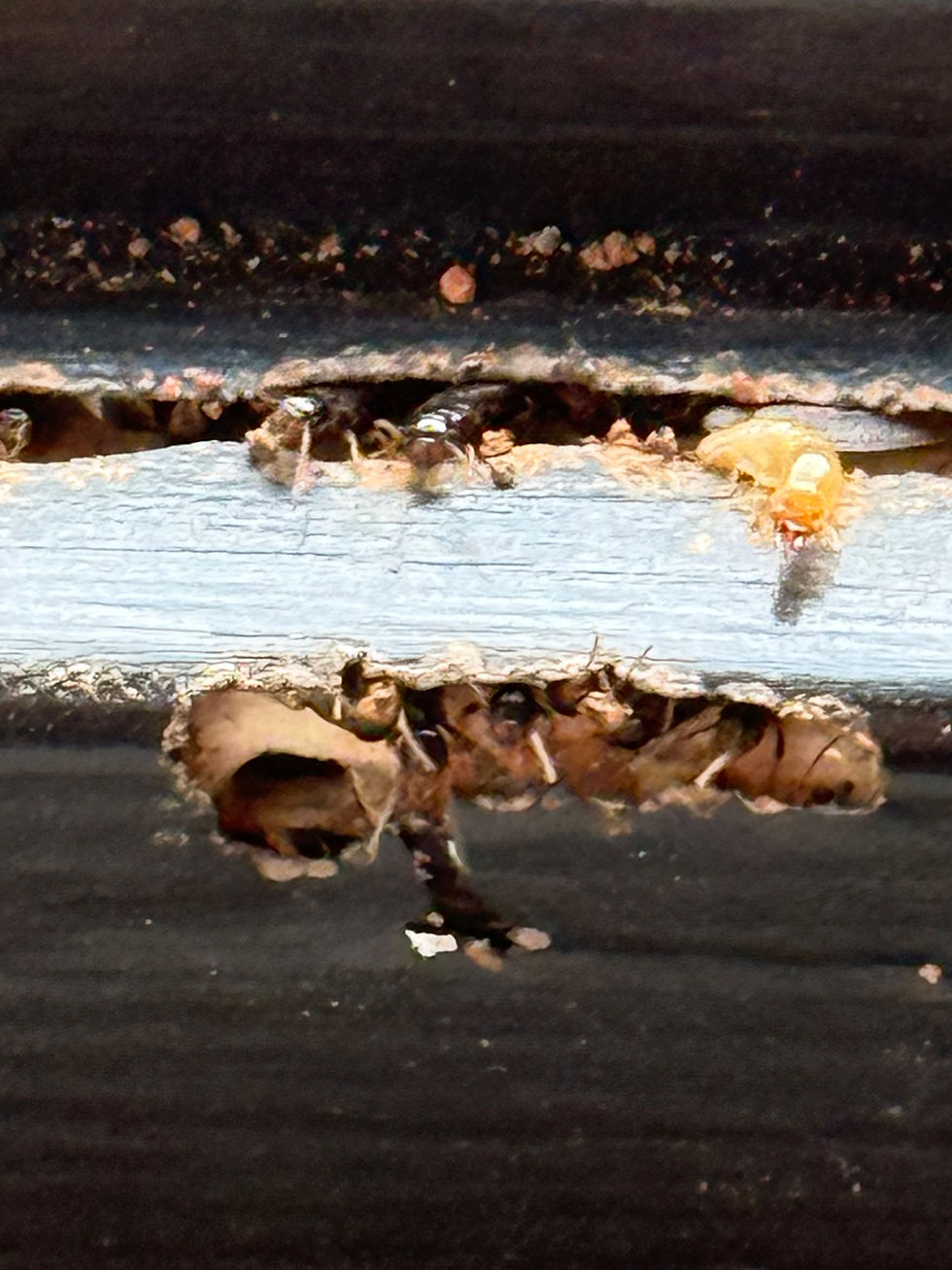
Termites are not always the hardest to kill, but they are the hardest to catch in time. Subterranean termites feed out of sight, inside wood and behind walls, and a colony can work for months or years before a homeowner sees any sign.
By the time you notice damaged wood or mud tubes, the colony has often been feeding for a long while. That is why a professional inspection matters even when nothing looks wrong. Treatment is highly effective when termites are found. We use Termidor liquid treatment and the Trelona ATBS Annual Bait System by BASF, and recommend whichever fits your home after an inspection. The difficulty is knowing you have a problem at all.
Ants: The Pest That Spreads When You Spray It

The ants that trail through Griffin kitchens, mostly odorous house ants and Argentine ants, form huge colonies with multiple queens. Because of that, killing the workers you can see changes nothing. The colony just sends out more.
Worse, repellent sprays can trigger budding, where part of the colony splits off and sets up a new nest somewhere else in your home. A homeowner who keeps spraying can end up with several colonies instead of one. This is why ants feel impossible to get rid of when you fight them with the wrong product.
Professional non-repellent baits and treatments work differently. Workers carry the product back to the colony and share it, reaching the queens. That eliminates the colony instead of scattering it.
Fire Ants: Tough Because the Queen Is Deep

You can destroy a fire ant mound and see a new one a few feet away within days. The queens live deep underground, and some colonies have more than one. Surface treatments of individual mounds often just move the colony.
Whole-yard broadcast bait is far more effective, because workers carry it down to the queens. The key is treating the colony, not the visible mound.
Many DIY fire ant products instruct the user to treat the mound directly. This will make the ants think they are being attacked. This can cause the ants to reject the bait or it can cause "budding" which is where the colony splits into two separate colonies. So when you hear someone treated for fire ants and it seems the ants multiplied there can be some truth to that.
Mosquitoes: Hard to Eliminate, Easy to Reduce
Mosquitoes are different because the honest answer is that no one can get rid of all of them. Female mosquitoes breed in standing water, and many breeding sites sit outside your control, in a neighbor’s yard, a drainage ditch, a creek, or a wooded low spot. New mosquitoes keep arriving.
What professional treatment can do is dramatically reduce the population in your yard. Our Basic, Green, and Premium Mosquito Programs each take a different approach, from barrier spray for fast knockdown to In2Care stations that work between visits to break the breeding cycle. You will not get zero mosquitoes, but you can get a yard you can actually use.
The Pattern Behind the Hardest Pests
Look across all of these and the same lesson shows up. The hardest pests to get rid of are the ones where most of the problem is out of sight, and where the obvious response, spraying what you can see, either does nothing or backfires. Getting rid of them means treating the source, whether that is the hidden cockroach population, the termite colony, the ant queens, or the breeding sites.
That is why the right answer is rarely “try harder with the same product.” It is to correctly identify the pest first, then use the method that reaches the source.
About Blasingame Pest Management
Blasingame Pest Management was founded by Billy and Shayne Blasingame in Griffin, Georgia in 2012. Billy is an Associate Certified Entomologist with a career in pest control since 1977. Our President Dylan Blasingame was named Commercial Technician of the Year by Pest Control Technology Magazine in 2024. Billy’s father, the late Bill Blasingame Sr., was a member of the Pest Management Professional Hall of Fame and one of the 80 most influential figures in the history of pest management in the United States — a legacy that runs through everything we do. We are BBB accredited and committed to honest, expert pest identification and treatment throughout Central Georgia.
Serving Griffin, Spalding County & Surrounding Areas
Griffin, GA | Spalding County | Experiment, GA | Orchard Hill, GA | Barnesville, GA | Zebulon, GA | Jackson, GA | Thomaston, GA | McDonough, GA | Stockbridge, GA | Hampton, GA | Locust Grove, GA | Jonesboro, GA | Newnan, GA | And all surrounding Central Georgia areas
Struggling With a Pest That Won’t Go Away? — (770) 914-1036
If you have been fighting the same pest for weeks and it keeps coming back, the problem is usually the method, not your effort. Call Blasingame Pest Management for a free inspection and we will identify what you are dealing with and tell you what will actually work.
📞 (770) 914-1036🌐 blasingamepest.com
Family owned and operated. BBB accredited. Proudly serving Griffin, GA and Spalding County.


